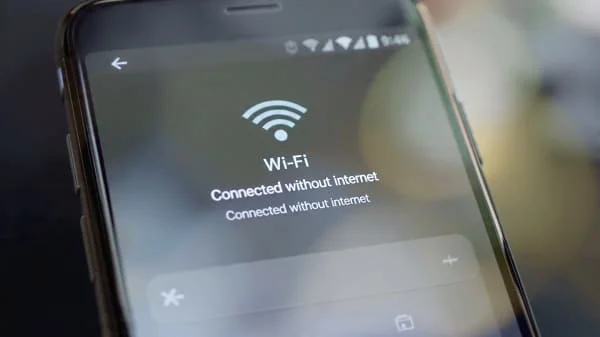
If your wifi connected but no internet samsung phone message keeps showing up, you’re dealing with one of the most confusing Android network problems: the phone connects to the router (Wi‑Fi icon appears), but apps don’t load, pages won’t open, and you may see an exclamation mark on the Wi‑Fi symbol. The good news is that this issue is usually fixable with a structured approach—starting with quick checks, then moving into Samsung-specific One UI settings, DNS/IP fixes, and finally router/ISP troubleshooting.
This guide is written for Samsung Galaxy phones (One UI) but most steps also apply to other Android devices. Follow it in order to solve the problem faster and avoid changing settings you don’t need.
Table of Contents
Why does my Android battery drain so fast overnight?
This heading is here intentionally because poor connectivity (like Wi‑Fi connected but no internet) can also cause extra battery drain overnight. When a phone keeps retrying connections, syncing repeatedly, or switching between Wi‑Fi and mobile data, it may stay more “awake” than it should. So fixing Wi‑Fi stability can improve both internet reliability and standby battery performance—especially if your Samsung shows frequent disconnect/reconnect behavior.
Value of This Article
This guide gives you a technician-style troubleshooting path to identify whether the issue is caused by your Samsung phone, your router, or your internet provider—then apply fixes in the safest order. You’ll learn practical steps that actually resolve “connected but no internet,” including Samsung One UI network toggles, DNS/IP corrections, and router settings—without risky apps or random guesswork.
1) What “Connected, no internet” really means on Samsung
When your Samsung says “Connected without internet” (or Wi‑Fi shows an exclamation mark), it usually means:
- Your phone successfully connected to the Wi‑Fi access point (the router).
- But your phone cannot reach the internet (DNS fails, gateway fails, or the ISP is down).
There are three main buckets of causes:
- Phone-side causes: VPN/Private DNS issues, corrupted Wi‑Fi profile, wrong IP/DNS, MAC randomization conflicts, buggy update.
- Router-side causes: DHCP errors, DNS issues, firewall/parental control blocks, band-steering bugs, outdated firmware.
- ISP-side causes: internet outage, PPPoE/authentication failure, line issues, or a modem problem even though Wi‑Fi is still broadcasting.
The rest of this article is designed to quickly determine which bucket you’re in.
2) Quick checks (solve it in 2–5 minutes)
Do these in order. They fix a large percentage of cases immediately.
A) Toggle Airplane mode (10 seconds)
- Turn on Airplane mode for 10 seconds.
- Turn it off.
- Reconnect to Wi‑Fi and test.
This refreshes Wi‑Fi and cellular radios and clears minor network glitches.
B) Restart the phone (simple, but effective)
Restarting clears stuck networking services and sometimes fixes “connected but no internet” instantly.
C) Restart the router/modem (the most ignored fix)
If you control the router:
- Unplug power for 30–60 seconds, then plug it back in.
- Wait 2–3 minutes, then test again.
D) Check if it’s only one app or everything
- Test two browsers (Chrome + Samsung Internet) and one app (YouTube/Play Store).
- If only one app fails, the problem might be the app, not Wi‑Fi.
E) Turn off VPN (if enabled)
A VPN can create a “connected but no internet” experience if it fails authentication or blocks DNS. Disable it temporarily and retest.
3) Test other devices to separate phone vs router vs ISP
This step prevents wasted time.
Scenario 1: Other devices also have no internet on the same Wi‑Fi
This strongly suggests a router/modem/ISP problem. Your Samsung is not the main issue. Move to Section 10 and consider contacting your provider.
Scenario 2: Other devices work fine, only your Samsung fails
This suggests a phone-side configuration problem (profile, DNS, IP lease, Private DNS, Intelligent Wi‑Fi, etc.). Continue to the next sections.
Scenario 3: The Wi‑Fi works, but it’s extremely slow or drops
That may be a weak signal, interference, or band-steering issue. See Section 9.
4) Forget the Wi‑Fi network and reconnect properly
A corrupted Wi‑Fi profile is a common reason for a wifi connected but no internet samsung phone problem—especially after a router password change or One UI update.
Steps (Samsung One UI)
- Go to Settings → Connections → Wi‑Fi.
- Tap the gear icon next to your network.
- Tap Forget.
- Restart your phone (recommended).
- Reconnect to the network and enter the password carefully.
Tip: Disable “Auto reconnect” temporarily
If the network keeps reconnecting to a bad profile state, turning off Auto reconnect (if shown) can help during troubleshooting.
5) The Samsung toggles that often cause this (Intelligent Wi‑Fi, VPN, Private DNS)
Samsung phones add network features that can improve stability—but in some environments they can cause “connected but no internet” behavior. Test these one by one (don’t change everything at once).
A) Intelligent Wi‑Fi features (Samsung)
Path can vary by One UI version, but look for:
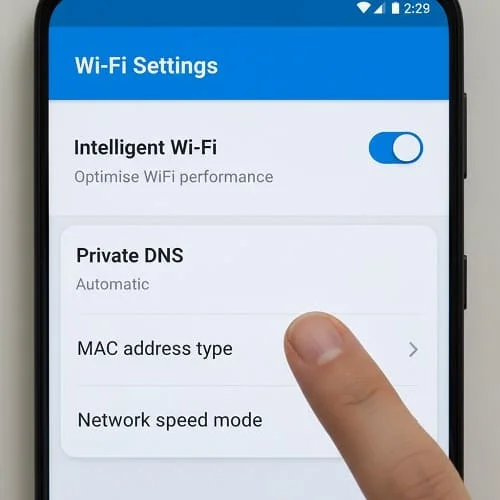
- Settings → Connections → Wi‑Fi → (three dots) → Intelligent Wi‑Fi
Temporarily disable features like:
- Switch to mobile data (or “Switch to better Wi‑Fi networks”)
- Detect suspicious networks (rarely causes issues, but test if needed)
- Wi‑Fi power saving mode (can cause instability on some routers)
B) Private DNS (very common culprit)
If you use an ad-blocking DNS (or a custom DNS that is down), many sites won’t resolve and it looks like “no internet.”
- Go to Settings → Connections → More connection settings → Private DNS.
- Select Automatic (or Off temporarily).
- Test internet again.
C) VPN / Work profile
- Disable any VPN app (or “Always-on VPN”).
- If you have a work profile (MDM), your organization policy may route traffic through a gateway that can fail. Test outside the work profile if possible.
D) Data Saver / Firewall apps
Some “data saver,” “security,” or firewall apps can block traffic and make Wi‑Fi look connected but unusable. Temporarily disable or uninstall for testing.
6) Captive portals, time/date, and sign-in networks (hotels, cafes)
If the problem happens in hotels, airports, schools, or cafes, your Wi‑Fi may require a sign-in page (captive portal). Your phone connects to Wi‑Fi but can’t access the internet until you accept terms or log in.
A) Force the captive portal page to appear
- Open a browser and visit a non-HTTPS site like http://neverssl.com (safe test site designed to trigger portals).
- Or try http://example.com.
If a sign-in page appears, complete it and test again.
B) Check Date & Time
Incorrect time can break secure connections (HTTPS) and make it appear that there’s no internet.
- Settings → General management → Date and time → Set automatically
C) “Sign in to Wi‑Fi network” notification
Swipe down notifications and look for a Wi‑Fi sign-in prompt.
7) IP address & DHCP problems (Invalid IP, IP conflict)
If your Samsung gets an incorrect IP address—or doesn’t get one at all—you can be connected to Wi‑Fi but have no working route to the internet.
How to check your IP details
- Settings → Connections → Wi‑Fi
- Tap the gear next to your network
- Look at IP address, Gateway, and DNS
Common signs
- IP address starts with 169.254.x.x (often means DHCP failed)
- Gateway is missing or unusual
- IP conflicts (two devices assigned the same IP)
Fixes
- Forget network and reconnect (renews DHCP lease).
- Restart router (clears DHCP table on many routers).
- Disable/enable Wi‑Fi to request a new IP.
Advanced: Switch IP settings to DHCP (or back)
On some Samsung versions you can change advanced IP settings on the network:
- Wi‑Fi network → gear icon → Advanced → IP settings
Ensure it’s set to DHCP unless you intentionally use a static IP.
8) DNS fixes (the most common “it’s connected but nothing loads” cause)
DNS is what turns website names (like google.com) into IP addresses. If DNS is broken, the phone can “have Wi‑Fi” but nothing opens.
A) Quick DNS test
Try opening:
- https://1.1.1.1 (Cloudflare)
- https://8.8.8.8 (Google DNS IP)
If those load but normal websites don’t, DNS is the issue.
B) Fix DNS on the Wi‑Fi network (Samsung)
- Settings → Connections → Wi‑Fi
- Tap the gear icon on your network
- Tap Advanced (if shown)
- Find IP settings / DNS
- Set DNS to a reliable provider temporarily:
- 1.1.1.1 and 1.0.0.1 (Cloudflare)
- or 8.8.8.8 and 8.8.4.4 (Google)
C) Fix Private DNS (again)
Even if Wi‑Fi DNS is fine, Private DNS can override it. Set Private DNS to Automatic and retest.
Reliable references for DNS and connectivity troubleshooting include: Google Help: Fix Wi‑Fi connection problems on Android and Samsung’s official troubleshooting resources: Samsung Support: Wi‑Fi troubleshooting.
9) 2.4 GHz vs 5 GHz vs Wi‑Fi 6: compatibility and stability fixes
Sometimes the phone “connects” but the connection isn’t stable enough to pass data reliably, especially with interference or router band-steering issues.
A) Try switching bands
- If you’re on 5 GHz and it’s unstable, test 2.4 GHz (longer range, more interference, but often more stable through walls).
- If you’re on 2.4 GHz and it’s crowded, test 5 GHz (faster, usually cleaner, shorter range).
If your router uses the same name (SSID) for both bands, you may need to split them temporarily in the router settings (e.g., HomeWiFi_2G and HomeWiFi_5G) for testing.
B) Wi‑Fi 6 / WPA3 compatibility
Some older devices or certain router firmware versions can be unstable with WPA3 or Wi‑Fi 6 features. If the issue started after changing router security:
- Test switching router security to WPA2-Personal temporarily.
- Update router firmware if available.
C) Interference sources at night
Microwaves, cordless phones (2.4 GHz), and crowded apartments can cause instability. A channel change on the router can help, but that’s a router-side step (next section).
10) Router-side fixes (what to change and what to avoid)
If multiple devices show “connected but no internet,” or your Samsung is the only device failing on this router, these router-side changes can resolve it.
A) Confirm the modem/ISP link is actually up
Many routers will still broadcast Wi‑Fi even if the internet line is down. Check the router’s internet light (WAN/Internet). If it’s red/orange/off, the ISP connection may be the issue.
B) Reboot properly (modem + router)
If you have a separate modem and router:
- Power off modem and router.
- Power on modem first; wait until it’s fully online.
- Power on router; wait 2 minutes.
C) Disable or review parental controls / firewall rules
Some routers block DNS, block new devices, or place devices into an isolated guest VLAN. Ensure your Samsung isn’t being blocked or assigned to a restricted profile.
D) Change DNS on the router (good long-term fix)
If the router’s default DNS is unreliable, set DNS on the router to Cloudflare or Google DNS. This improves internet stability for all devices.
E) Update router firmware
Outdated firmware can create DHCP/DNS bugs and band-steering problems. If your router supports updates, apply them.
What to avoid during troubleshooting
- Don’t enable multiple “internet accelerator” features at once.
- Don’t keep switching security modes repeatedly without documenting what you changed.
- Don’t factory reset the router until you’ve tried the simpler steps (or you may lose ISP settings).
11) Updates, corrupted network profiles, and Safe Mode testing
Software glitches can cause Wi‑Fi to connect but fail to route traffic correctly.
A) Update your Samsung phone
- Settings → Software update → Download and install
B) Update Google Play system components
- Settings → Security and privacy → Updates → Google Play system update
C) Try Safe Mode (to rule out VPN/firewall apps)
Safe Mode disables third-party apps temporarily. If Wi‑Fi works in Safe Mode, a downloaded app (VPN, firewall, ad blocker, “optimizer”) is likely interfering.
- Common method: hold Power → press and hold “Power off” → Safe mode (varies by model)
12) Reset network settings (when to do it and what it deletes)
If you’ve tried the earlier steps and the problem persists only on your Samsung, a network reset is often the cleanest fix.
What it resets
- Saved Wi‑Fi networks
- Bluetooth pairings
- Some cellular/network configurations
How to do it on Samsung
- Settings → General management → Reset
- Tap Reset network settings
- Confirm and restart the phone
Afterward, reconnect to Wi‑Fi and test before installing or enabling VPN/Private DNS again.
13) Use mobile data as a workaround (and what to do if it also fails)
If Wi‑Fi isn’t working, you can temporarily use mobile data. If mobile data also fails on your Samsung, the problem might be broader (APN, SIM, network mode, carrier outage).
Use this guide for mobile data troubleshooting: mobile data not working samsung
Important testing tip: If mobile data works but Wi‑Fi doesn’t, your phone is fine—focus on Wi‑Fi settings/router. If neither works, check VPN/Private DNS, airplane mode, SIM status, and carrier service.
Video: Fix WiFi Connected But No Internet on Samsung Galaxy Phone
This embedded player loads relevant walkthroughs from YouTube search results for Samsung Wi‑Fi connected but no internet fixes:
FAQ
Why does my Samsung say connected to Wi‑Fi but no internet?
Usually DNS/Private DNS issues, VPN interference, a bad IP/DHCP lease, or the router/ISP internet link being down while Wi‑Fi still broadcasts.
Does “connected without internet” mean my phone is broken?
Most of the time, no. It typically means a configuration conflict or a router/ISP problem. Use Battery usage and network tests to isolate whether it’s your phone or the network.
Will resetting network settings delete my photos or apps?
No. It only resets network-related items like Wi‑Fi and Bluetooth. You will need to re-enter Wi‑Fi passwords and re-pair Bluetooth devices.
Can Private DNS cause no internet?
Yes. If you set a custom Private DNS (especially an ad-blocking DNS) and it’s unavailable or blocking required domains, many apps won’t load even though Wi‑Fi is connected.
What if other devices work but my Samsung doesn’t?
Forget the network and reconnect, disable VPN/Private DNS, test Safe Mode, and consider a network settings reset. Also try switching between 2.4 GHz and 5 GHz bands.
Final checklist
- Restart phone and router/modem.
- Check if other devices have internet on the same Wi‑Fi.
- Disable VPN and set Private DNS to Automatic/Off.
- Forget Wi‑Fi network and reconnect.
- Check IP (avoid 169.254.x.x) and renew DHCP by reconnecting.
- Test DNS (try 1.1.1.1 / 8.8.8.8) and set reliable DNS if needed.
- Switch Wi‑Fi band (2.4 ↔ 5 GHz) and test.
- Try Safe Mode to rule out third‑party interference.
- Reset network settings if the issue is phone-specific.
- If Wi‑Fi still has no internet across devices, contact ISP or check router WAN status.
By following these steps in order, you can solve most wifi connected but no internet samsung phone cases quickly and safely—without unnecessary factory resets or risky apps.

About the Author
Alex Carter — Founder & Editor‑in‑Chief, GicraMobile
Alex leads GicraMobile’s testing lab and reviews. His methodology focuses on day‑to‑day performance, battery health and thermals, camera consistency, and 5G/LTE reliability—so you can pick the right phone without hype.
Real‑world testing: 90–120 Hz smoothness, idle drain, thermals
Camera checks: HDR, skin tones, low‑light stabilization
Connectivity: band fit, eSIM, VoLTE/VoWiFi, Wi‑Fi performance
You may also like this